
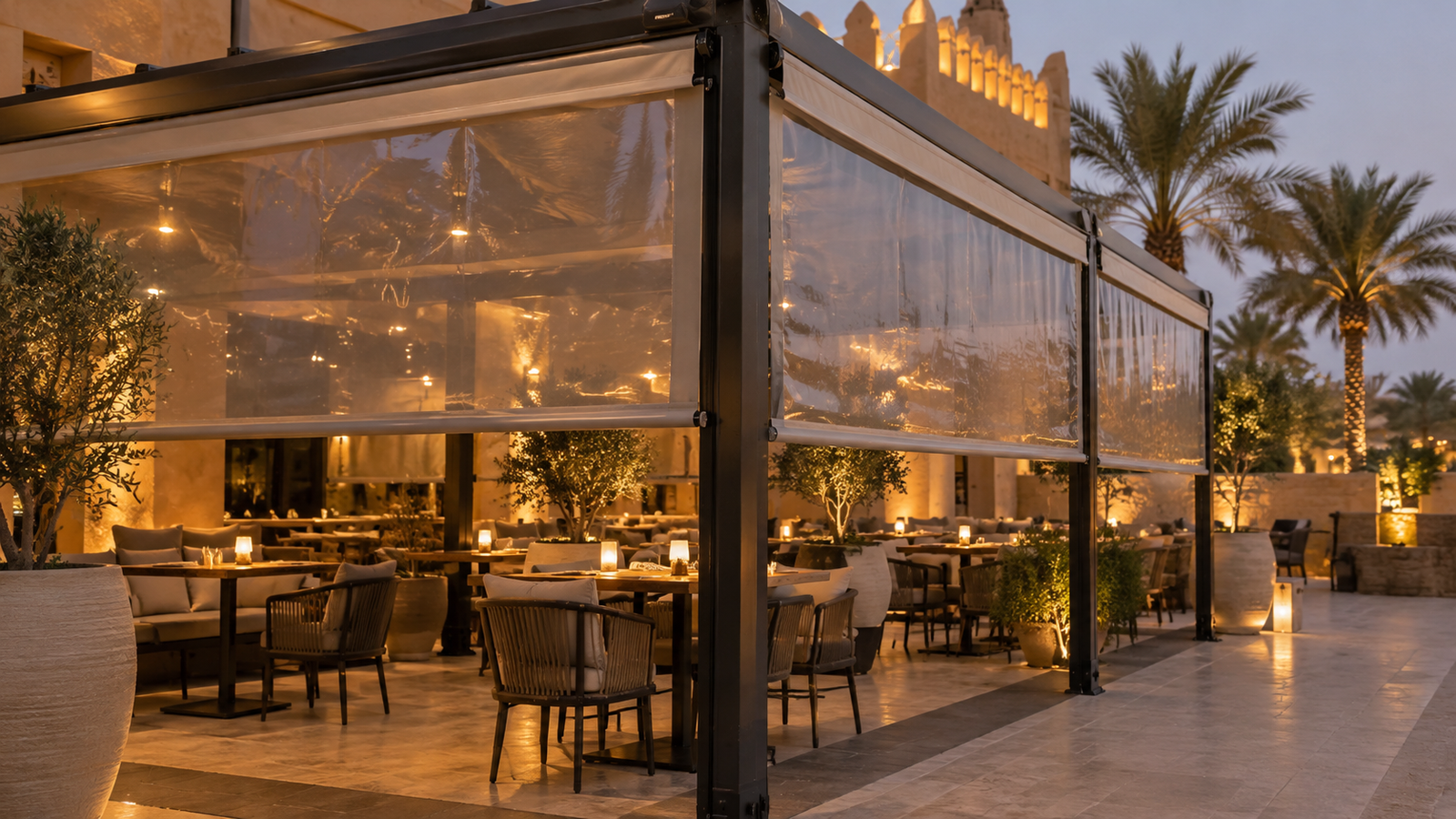

Outdoor seating is one of the spots guests like most, but it is also the most exposed to sun, wind, dust and sometimes rain. Zipper curtains help here: outdoor curtains that lower and raise as needed and protect the seating from the weather. This guide explains how they work, their types, and how to choose the right fabric, motor and size for your restaurant or café, with the mistakes to avoid before signing a contract.
Why Do Restaurants Need to Protect Outdoor Seating?
Guests do not stay in a hot or dusty place, and if they sit down they do not stay long. Protected seating means more comfort, longer operating hours, and better use of the outdoor space you already pay rent and fit-out for. Many restaurants discover their outdoor seating is effectively “dead” half the year because of sun or dust, while the right curtains keep it running most days of the year.
Beyond guest comfort, protection keeps furniture and upholstery safe from sun and dust, cuts daily cleaning costs, and gives the facade a tidy, professional look.
What Are Zipper Curtains and How Do They Work?
An outdoor curtain runs down two side channels and is secured at the edges with a zip-style closure so it resists wind and does not flap. It opens and closes with an electric motor or manually, depending on the type. The key difference from ordinary curtains is the side fixing that keeps it stable even in wind, and that is exactly why it spread so widely in outdoor seating.
Types of Outdoor Seating Curtains
The choice between types depends on how exposed the site is to wind and on the shape of the seating. If the seating is in an open spot or a ground floor that gets side wind, zipper curtains are usually the right choice.
| Curtain type | Fixing method | Best for |
| Zipper curtains | Two side channels with zip fixing | Open seating exposed to wind |
| Outdoor roller curtains | Top roll with no side fixing | Areas relatively sheltered from wind |
| Outdoor aluminum curtains | Slats, often with light control | Those wanting light control with product-dependent durability |
Choosing the Right Material
The fabric matters: some fabrics block more sun and some keep the view outside. Ask about the fabric’s resistance to UV, tearing and dust, and whether it can be cleaned. With transparent or mesh fabrics you can keep the seating’s view while softening the sun, which matters for restaurants where the view is part of the experience.
A practical tip: ask for a fabric sample and test it at the site itself at noon before approving it, because the shading level in photos differs from reality.
Choosing the Motor and Operation
An electric motor suits large areas. Ask about the motor warranty and wind protection, and whether remote or central control is possible. For restaurants with more than one curtain, central control saves daily operating time: one button lowers all curtains before peak time.
Protection from Sun, Wind, Dust and Rain
- Sun: the fabric density decides how much light passes.
- Wind: side fixing helps keep the curtain stable.
- Dust: closing the sides clearly reduces how much gets in.
- Rain: some fabrics resist water, but check the actual specifications.
Note that each factor has a partial solution, and the best results come from combining the curtains with an overhead awning, especially for vertical noon sun.
How to Determine Sizes
Measure the width and height accurately and note the columns and movement paths. A wrong size means gaps that let wind in or a curtain that does not drop fully. It is always better for the installation technician to take the measurements on site rather than relying on sent measurements, because a few centimeters of error show up as a gap in operation.
Cost Factors for Zipper Curtains
- Size and total area.
- Fabric type.
- Motor and control.
- Installation difficulty.
- Warranty and after-sales service.
We recommend asking for a detailed quote instead of relying on a per-meter price alone, because details like fabric type and motor brand make a big difference in both price and quality.
Installation and Execution Steps
- Site visit and measurements.
- Choosing the fabric and motor.
- Preparing the channels and fixings.
- Installing the curtain and testing operation.
- Handover with maintenance guidance.
Mistakes to Avoid
- Choosing a curtain by looks alone.
- Ignoring wind direction.
- Taking inaccurate measurements.
- Choosing a motor weaker than required.
- Forgetting to plan cleaning and maintenance from the start.
Questions to Ask Before Contracting
- What fabric is used and what are its specifications?
- What is the warranty on the motor and fabric?
- Does installation include testing and handover?
- Who handles maintenance?
- Are spare parts for the motor and fabric available locally?
A Practical Example: A Restaurant with an Open Frontage
Imagine a restaurant with outdoor seating on a west-facing open frontage: afternoon sun comes straight in, wind moves any ordinary curtain, and dust settles on tables before the evening rush. The answer here is usually combining an overhead awning that stops the direct sun with side zipper curtains that close when needed. Once the curtains drop half an hour before peak time, the seating turns from an effectively closed area into one that welcomes guests every day, and that is the real return on the investment.
Daily Care for the Curtains
Care is simple but needs consistency: wiping the fabric regularly in a way that suits its type, checking the side channels for dust build-up, and running the curtain through a full cycle every so often to confirm the motor is healthy. Restaurants that add these steps to their weekly cleaning schedule rarely face surprise failures in peak season.
Frequently Asked Questions
Do zipper curtains block rain?
Some types resist water. It is best to confirm the product’s actual specifications.
Can they be combined with awnings?
Yes, and combining them gives better protection. See our article: Protecting Outdoor Seating in Restaurants.
Do they withstand strong wind?
They do, depending on the design and fixing, and in very strong wind it is best to raise them.
Can they be operated from a phone?
If the motor supports smart systems, they can be linked to central control or an app. Ask about compatibility before buying.
Do they suit home seating areas too?
Yes, the same idea applies to villa and rooftop seating, with sizes and fabrics chosen for the use.
Read Also
Protecting Outdoor Seating in Restaurants: Practical Solutions Against Sun, Dust, and Wind
Aluminum Blinds: When to Choose Them Over Fabric Curtains?
Want to Protect Your Restaurant’s Seating?
Contact Steam Trading and we will help you choose the right solution for your space.