
Many people mix up smart film and window tinting film, though each does a different job. One controls privacy at the press of a button, and the other reduces heat and glare permanently. This article explains the difference in detail, with a full comparison and examples from villas, offices and restaurants, so you can pick the right one for your facility.
What Is Smart Film?
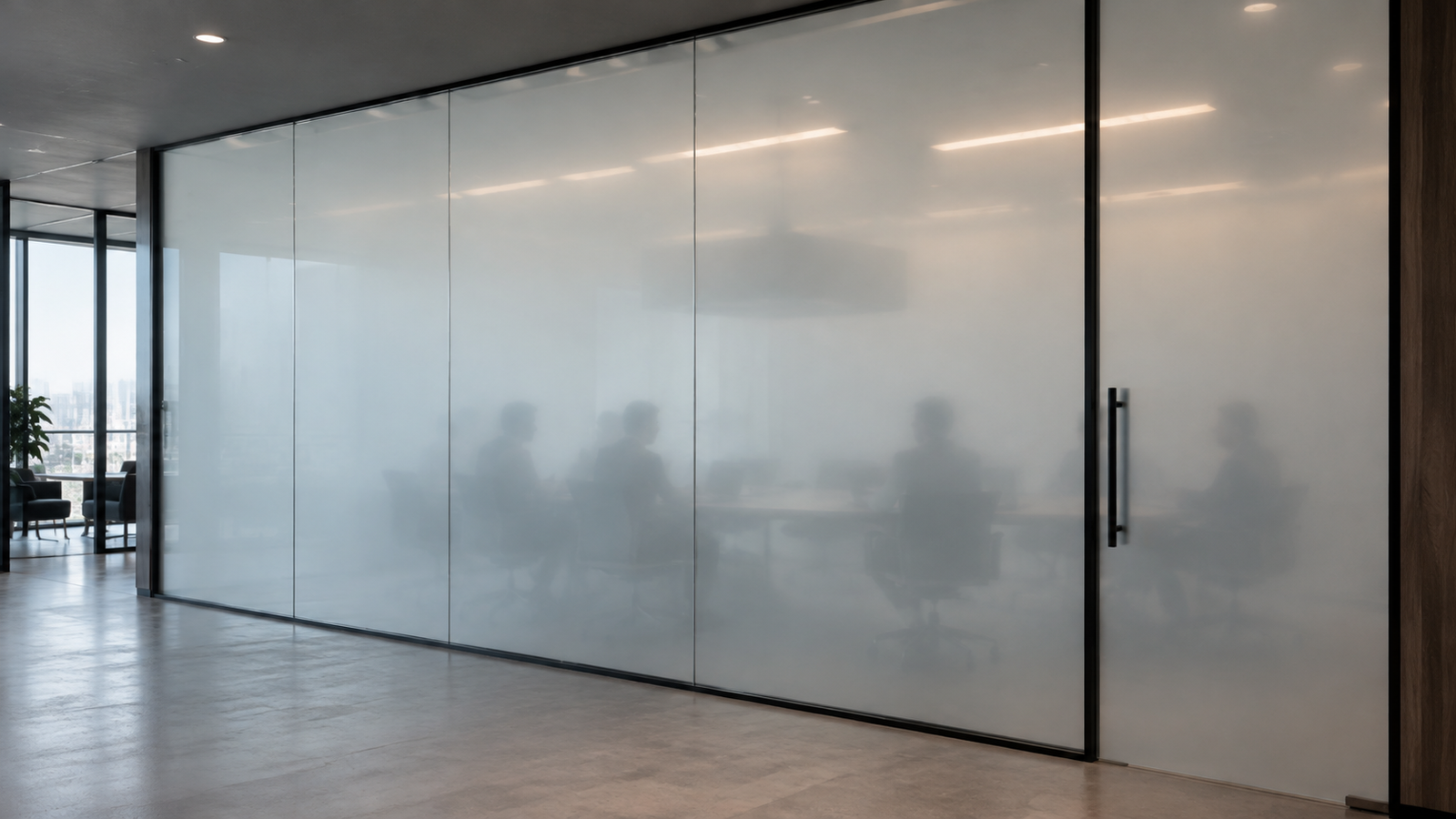
Smart film switches from clear to opaque (or nearly opaque) under electric control. It is often used in meeting rooms, offices and glass facades that need privacy on demand. Its core advantage is giving you clear glass and privacy in the same place, instead of choosing one of them permanently.
How Does PDLC Technology Work?
PDLC means liquid crystals spread inside the film. With no power the particles are random, so the film looks opaque. With power they line up and the film turns clear. This is a general description of the technology, and details vary by product. What matters to you as a user: the switch happens at the press of a button or from a control panel, and the glass needs a power connection.
What Are Window Tinting Films?
Tinting films are layers applied to glass to reduce glare, heat and incoming sunlight, giving a dark or reflective look depending on type. They work all the time, need no electricity and no control, and that simplicity is exactly why they are so common.
The Difference in Privacy
Smart film gives privacy whenever you want it: clear when you want the view, opaque when you want privacy. Some tinting films, especially reflective ones, limit the view from outside during the day, but they do not give full privacy at night when the interior is lit. This depends on the film type, and it is a point many people miss: reflective tinting “works by day more than by night”.
The Difference in Control and Transparency
- Smart film: you control the state whenever you want, and it can be linked to a panel or a smart system.
- Tinting film: a fixed state that does not change after installation.
The Difference in Heat and Glare Reduction
Tinting films are usually designed to cut heat and glare; that is their main purpose. Smart film focuses on privacy, and its effect on heat varies by product, so ask for its specifications if heat reduction is one of your goals. If your first goal is cutting solar heat and the AC bill, tinting film is the tool designed for that job.
Can the Film Be Installed on Existing Glass?
Usually yes, but it depends on the glass type and condition, and smart film needs wiring and a power supply. A site visit is recommended before deciding, because some glass types or older facades need special preparation, and some may not suit certain film types at all.
Smart Film or Tinting for Villas?
If you care about reducing heat and glare, tinting is a practical choice. If you want controlled privacy (for example a bathroom, a lounge, or a facade facing neighbors), smart film suits better. Some people use both in different parts of the same villa: tinting on the sunny facades, and smart film where variable privacy is needed.
A practical example: a villa whose west facade gets strong afternoon sun uses tinting film to cut heat permanently, while its glass guest lounge uses smart film to get privacy only when needed.
Which Suits Offices and Restaurants?
Offices and meeting rooms benefit from smart film because privacy there is needed intermittently: a confidential meeting now, an open space an hour later. Restaurants and large facades benefit from tinting to cut glare and heat for guests throughout working hours. In offices generally, glass meeting rooms are where the difference shows most.
Full Comparison Table
| Criteria | Smart film | Tinting film |
| Privacy | Controlled, whenever you want | Fixed, depending on type |
| Operation | Electric and controlled | No electricity |
| Heat and glare | Varies by product | Its main purpose |
| Installation | Needs power wiring | Applied to glass only |
| Best for | Meeting rooms and privacy on demand | Villas and sunny facades |
Factors for Choosing the Right Solution
- Your goal: privacy or heat reduction.
- Glass type and area.
- Budget.
- Availability of power.
- Do you prefer a fixed solution or variable control?
Common Mistakes When Choosing Between the Two Films
- Buying smart film mainly to cut heat without confirming its thermal specifications.
- Expecting full night privacy from a reflective tinting film.
- Forgetting to prepare a power point before installing smart film.
- Choosing a tint so dark that it hurts natural lighting inside.
Questions to Ask the Supplier Before Installation
- What are the exact heat and UV reduction figures for the proposed film?
- Is the product suitable for my existing glass type?
- How long is the warranty and what does it cover?
- Does installation include a site visit and post-installation testing?
- For smart film: are the power supply and wiring included in the quote?
Frequently Asked Questions
Does smart film reduce heat?
It depends on the product, so check the specifications; some products add certain insulation properties but are not a guaranteed substitute for dedicated tinting film.
Can it be removed?
Usually yes, but the process needs care depending on the glass type.
Do I need an awning with the film?
An awning reduces direct sun before it reaches the glass and works as a complement. See: Window Tinting Film for Villas: Does It Really Reduce Heat?.
Does smart film need maintenance?
It needs careful cleaning with suitable products and checks of the electrical connections over time. Ask the supplier for the product’s care instructions.
Does smart film turn off when the power cuts?
With the common technology the film returns to its opaque state when power is cut, but confirm the behavior of the specific product with the supplier.
Read Also
Window Tinting Film for Villas: Does It Really Reduce Heat?
Need Help Choosing a Film?
Contact Steam Trading and we will help you choose based on your use.