
If you are planning a retractable awning for your villa, restaurant or café, you will likely stop at one question: aluminum or PVC? Both work, but each suits a different kind of use. The wrong material can mean extra heat, too much maintenance, or an awning that does not fit the seating area. This article explains the difference in detail, with a full comparison and practical examples, so you can decide based on what you actually need rather than how the awning looks in photos.
Why Does the Awning Material Matter?
An awning faces sun, dust and wind every day, and sometimes rain. The material decides how it handles these conditions, how much maintenance it needs, and how it looks after years of use. It also decides how you control light and ventilation in the space, which makes a real difference to the comfort of everyone sitting under it, especially in the hot Saudi climate.
Many people choose on price or appearance alone, then discover a year or two later that the awning does not match how they actually use the space: it traps heat, or needs constant cleaning, or does not handle the local wind. Understanding the difference between the two materials before buying saves you the cost of replacing the whole system later.
What Is the Difference Between Aluminum and PVC Awnings?
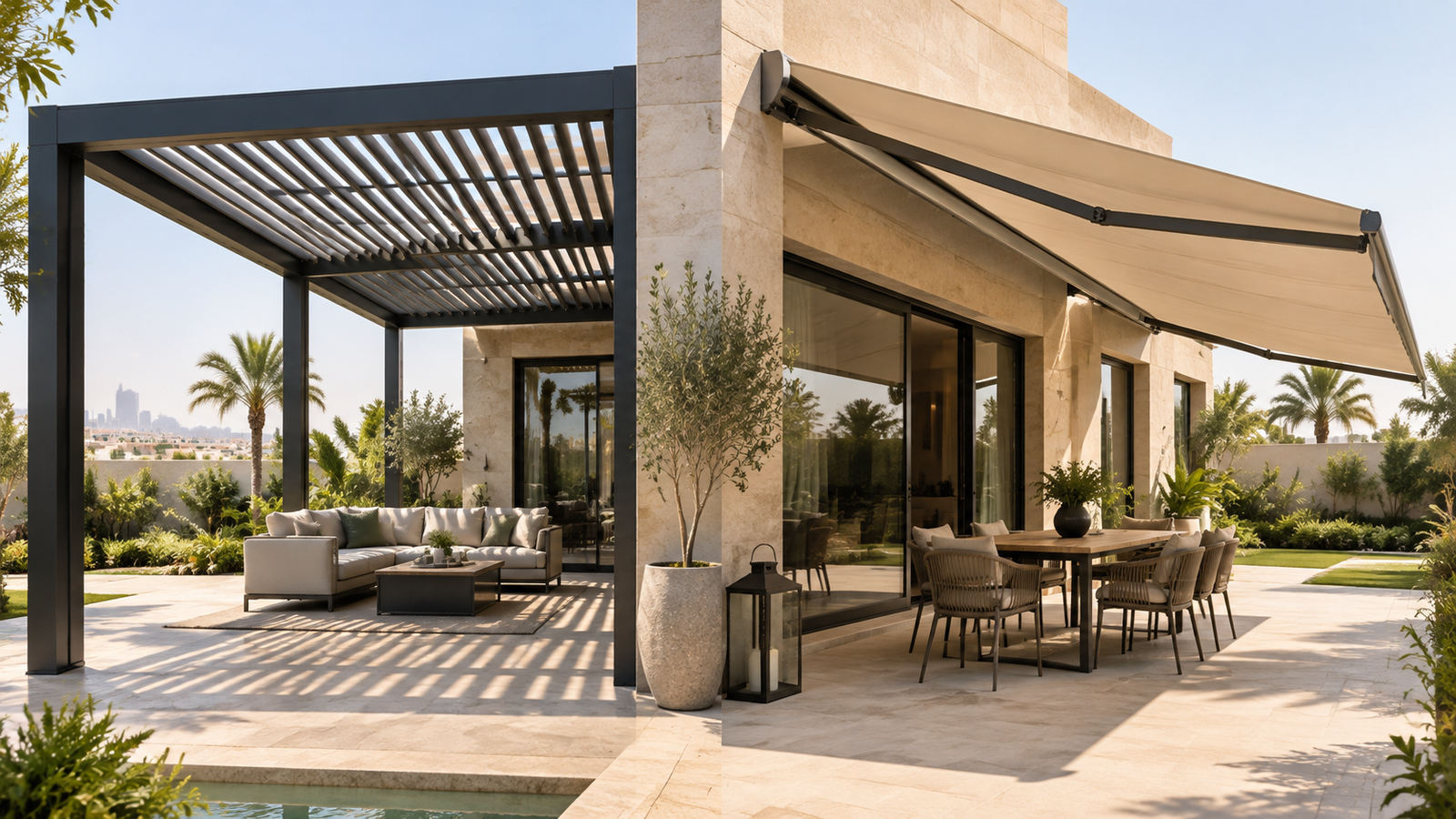
Movable aluminum awnings usually rely on aluminum louvers that rotate to control light and airflow, and they form a fixed architectural element of the building. Electric PVC awnings use a PVC fabric that opens and closes with a motor, covers the whole area when extended, and almost disappears when retracted.
- Aluminum: rotating louvers, finer control of light and ventilation, a fixed architectural look.
- PVC: fabric that folds and extends, with continuous coverage when extended.
In short: aluminum is a shading system that “works all day” through small adjustments of the louver angle, while PVC is a coverage system you “open and close” as needed. This difference in how each is used is the basis of every comparison below.
Comparing Shading, Ventilation and Light
Louver awnings let you open the louvers partly, so air and soft light come in while direct sun stays out. You can adjust the angle as the sun moves through the day, which gives real control over the seating atmosphere. PVC gives continuous coverage that blocks sun and rain completely when closed, and leaves the area fully open when retracted.
If you want precise control of air and light through the day, aluminum fits better. If you want full coverage quickly at specific times only, PVC is a good choice. A practical example: a restaurant seating area that runs from noon to night benefits from aluminum louvers because they adapt hour by hour, while seating used only in the evening may be fine with PVC opened at peak time.
Resistance to Sun, Rain and Weather
Resistance to sun, dust, rain and wind depends on the specific product, not only on the material. For aluminum, ask about the coating and finish, because a good coating is what preserves the color and resists heat and scratches. For PVC, ask about the fabric, stitching, welds and tension, because the weak points are usually in these details rather than the fabric itself.
For either option, ask about the exact material, the motor specifications and wind tolerance, because these differ from product to product. And if your area is dusty or close to the sea, mention that to the supplier from the start so they suggest the right finish.
Aluminum or PVC for Villas?
Villas usually need an awning that lasts for years and becomes part of the facade. Aluminum gives a fixed, elegant look and suits roofs, gardens and permanent seating, and it matches the “permanent structure” idea most villa owners look for. PVC suits spaces where you want fabric coverage that extends when needed and leaves the sky open when retracted, especially seating used seasonally.
An example: a villa with a pool and outdoor seating used almost daily benefits from aluminum louvers giving constant control without opening and closing the whole awning every time. A winter seating area used only for occasions can be served well by a PVC awning.
Aluminum or PVC for Restaurants and Cafés?
In restaurants, guest comfort and fast operation matter. Louver awnings let air through when the louvers are open, which suits areas that run all day. PVC suits seating that needs full coverage when required and open sky afterward. The decision depends on the sun’s direction, daily operating hours and the layout of the seating.
And if your seating faces side wind or dust, combining the awning with side curtains is sometimes the best answer. See our article on protecting outdoor seating in restaurants for how to combine the systems.
Maintenance and Service Life
- Aluminum: regular cleaning of louvers and channels, and checks of the motor and joints.
- PVC: cleaning the fabric, checking stitching, welds and tension, and checking the motor.
Service life depends on installation quality, the material and operating conditions, so we do not give a fixed number. What we can say: simple regular maintenance is what preserves any system, aluminum or PVC, and neglecting it shortens the life of even the best products.
Electric Control and Smart Features
Both support electric operation and remote control. If you want to connect them to a smart home or a wind sensor that closes the awning automatically when needed, ask the supplier about compatibility from the start, since not every motor supports it. For details, see our article: How to Connect Awnings and Blinds to Your Smart Home System?.
What to Check in a Price Quote
- Material type, thickness, and the type of coating or fabric.
- Motor brand and warranty.
- Awning dimensions and the mounting method.
- Wind tolerance and protection method.
- Warranty and after-sales service.
Do not compare two quotes by the final price alone; compare them at the same specifications. A cheaper quote with weaker specs can cost you more in the long run through maintenance or early replacement.
Common Mistakes When Choosing Between Aluminum and PVC
- Choosing by appearance only, without thinking about daily use.
- Assuming all products of one material are equal in quality.
- Ignoring the sun and wind direction at the site before deciding.
- Forgetting to ask about motor compatibility with smart systems if you plan them.
- Relying on a per-meter price without comparing full specifications.
Full Comparison Table
| Criteria | Aluminum awnings | PVC awnings |
| Light and ventilation control | Precise, through louver rotation | Depends on opening or closing |
| Coverage | Movable louvers | Continuous fabric |
| Weather resistance | Depends on coating and finish | Depends on fabric, stitching and tension |
| Maintenance | Cleaning louvers and motor | Cleaning fabric, checking tension and motor |
| Best for villas | Permanent projects and daily seating | Shade that extends when needed |
| Best for restaurants | Ventilation and all-day operation | Full coverage when needed |
Frequently Asked Questions
Which is better for rain?
It depends on the design, installation and how well it seals. Ask the supplier about the specific product’s drainage ability.
Can I use both in the same project?
Yes, each type can serve a different area as needed; for example aluminum over the main seating and PVC over a secondary one.
Is aluminum more expensive than PVC?
Price varies with size, motor and design, so compare two quotes for the same size and specifications.
Which is faster to install?
Installation time depends on project size and site preparation more than on the material itself, and the supplier sets the schedule after a site visit.
Are aluminum awnings noisy in the wind?
Good installation and healthy joints reduce any vibration or noise, so raise this concern with the supplier during the site visit.
Which is easier to clean?
Aluminum needs wiping of louvers and cleaning of channels, and PVC needs fabric cleaning with products suited to its type. The effort is similar; the method differs.
Read Also
Adjustable Aluminum Awnings: Advantages, Uses, and How to Choose Them
Electric PVC Awnings: Advantages and Disadvantages Before You Buy
Need Help Choosing an Awning?
Contact the Steam Trading team and we will help you choose the right solution for your project based on location and use.