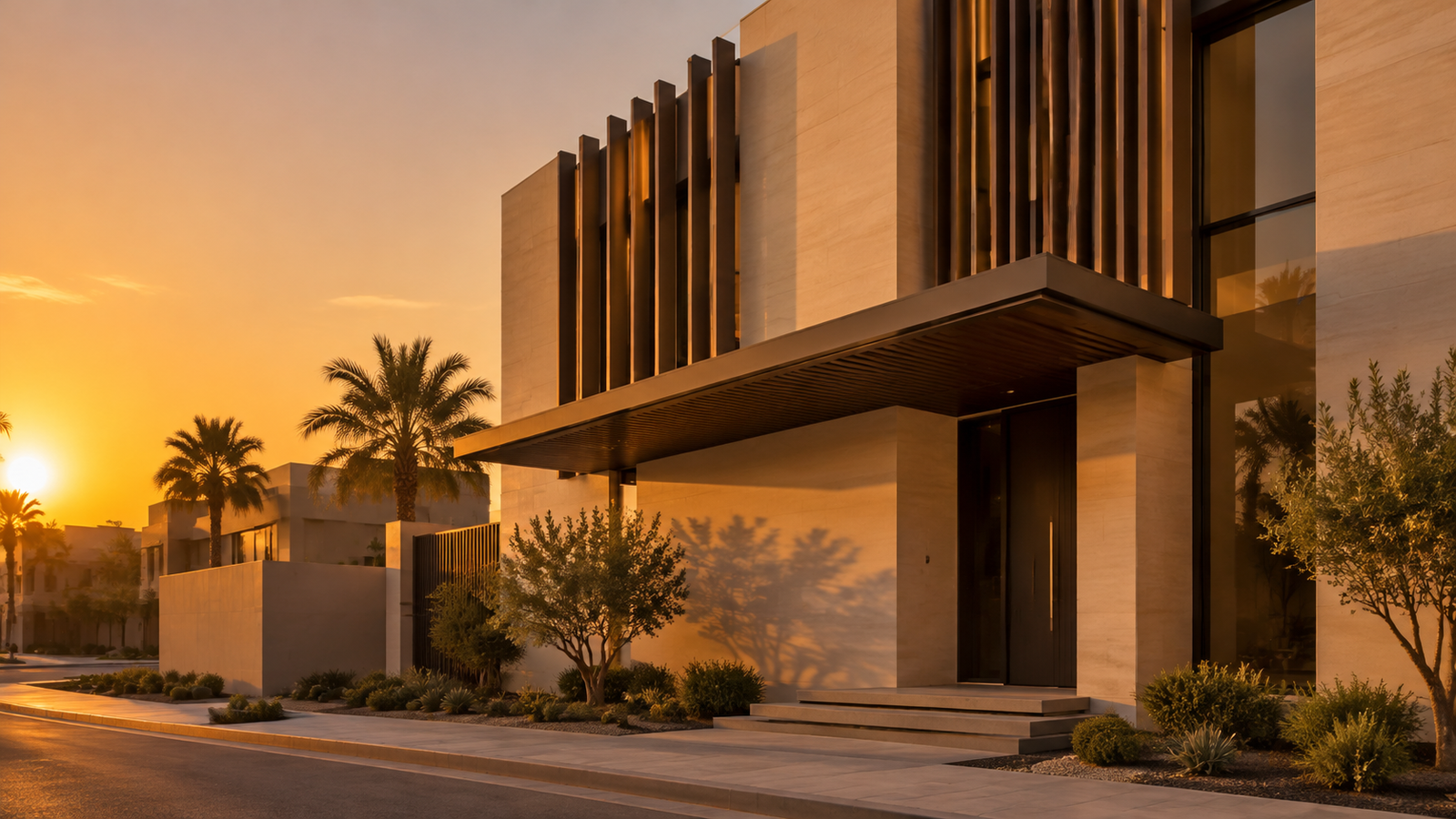

If you have a villa, restaurant, or commercial building in Saudi Arabia, you have probably noticed that some facades are harder to deal with than others in terms of heat and sunlight.
West- and south-facing facades need special attention when choosing a shading system, because the right solution is not just installing an awning and calling it done.
You need to know the sun’s direction, exposure time, glass size, the nature of the facade, and whether you need protection from the sun only or also privacy and better use of the outdoor space.
Why Is the West Facade Troublesome?
The western sun is relatively low during part of the day, especially near the afternoon.
This makes the rays enter at different angles compared to the high midday sun.
So you may notice that a simple horizontal awning is not enough on its own for some west-facing windows.
Here you need to think about vertical or adjustable shading, or combining more than one solution.
And What About the South Facade?
The south-facing facade is exposed to the sun differently throughout the year.
And in Saudi Arabia, shading must be designed based on the building’s direction and location, not just the name of the direction.
So site assessment is very important before choosing a product.
Best Facade Shading Solutions
1. Outdoor Awnings
Outdoor shading is one of the basic solutions for reducing direct sunlight reaching the glass or the space to be protected.
Possible solutions include:
- Fixed awnings.
- Arm awnings.
- Adjustable awnings.
- Electric awnings.
- Aluminum louver awnings.
Each type has a different use.
So you can see awning solutions and compare them according to the nature of the project.
2. Adjustable Aluminum Awnings
If you need greater control over light and ventilation, adjustable aluminum louver awnings can be a suitable option.
The core advantage is that the louvers can move according to the system used, giving you greater control than a fixed awning.
This type can suit villas, restaurants, terraces, and outdoor seating areas.
3. Outdoor Curtains
On some facades, especially those with seating areas or large openings, outdoor curtains can add an extra layer of protection.
They help reduce direct sun exposure and improve privacy, depending on the material type and design.
4. Roller Blinds or Window Shading Systems
If your main problem is sun entering through the windows, you may need a window shading system instead of relying on an outdoor awning alone.
The choice depends on the glass type, window area, and facade direction.
5. Combining More Than One Solution
In some projects, the best result does not come from one product.
For example:
Outdoor awning + outdoor curtain + glass shading
This can be better than relying on a single element, especially on facades strongly exposed to the sun.
How Do You Choose the Right Solution?
Before choosing, answer these questions:
When Does the Sun Enter?
Is the problem in the morning? At noon? In the afternoon?
Timing matters because it defines the sun’s angle and the right solution.
Where Does the Sun Enter?
Does it enter from the roof? From the windows? From the sides? From an outdoor seating area?
How Large Is the Facade?
The larger the area, the more important the choice of system, frame, and fixing method becomes.
Do You Need Movement?
If you need opening and closing according to time and weather, electric awnings or adjustable systems are more flexible.
Do You Have Outdoor Seating?
If yes, do not focus only on the facade.
You need to account for the protection required for the seating area itself.
Ranking Solutions by Use
We cannot say there is one solution that is best for all buildings, but the options can be divided as follows:
For strong outdoor protection:
Outdoor awnings and adjustable systems.
For light control:
Louver awnings and light-control blinds.
For outdoor seating areas:
Awnings + outdoor curtains, depending on the location.
For windows:
Indoor or outdoor shading systems, depending on the design.
For smart solutions:
Electric systems that can be connected to control systems.
A Common Mistake: Focusing on Appearance Alone
Sometimes a customer chooses an awning because they liked it in a photo of another project.
But the project’s conditions may be completely different.
For example:
- A different direction.
- A different area.
- A different height.
- Different wind.
- A different sun angle.
- A different use.
So a photo alone is not enough to make a decision.
A Practical Example for a Villa with a West Facade
If you have a large majlis with a west-facing facade and wide glass, the main problem may be sun entering in the afternoon.
In this case, the solution may rely on combining:
Outdoor shading + suitable blinds + glass treatment when needed.
But if the problem is in an outdoor seating area, the focus may be more on the awning and side curtains.
A Practical Example for a Restaurant
If you have a restaurant with outdoor seating on a west-facing facade, the problem is not just heat.
You also have:
- Customer comfort.
- Preserving the seating areas.
- Light control.
- Speed of operation.
- Overall appearance.
- Daily operation.
Here an electric system can be useful if the seating areas need coverage adjusted more than once during the day.
Does Shading Reduce Heat Inside the Building?
Outdoor shading can reduce direct sunlight reaching the facade and glass, and therefore helps reduce the heat load caused by solar radiation.
But the final result depends on many factors, such as:
- Glass type.
- Glass area.
- Facade direction.
- Shading type.
- Installation method.
- Insulation.
- Site conditions.
So I do not recommend relying on a fixed savings percentage without studying the building.
Mistakes to Avoid
Installing the Same System on All Facades
The east facade is not like the west, and the south facade is not like the north.
Ignoring the Glass
Sometimes the customer focuses on the awning and forgets that the glass area itself is large.
Choosing a System Without Studying Wind
Especially for adjustable and lightweight systems.
Choosing Dimensions Randomly
Span, height, and shading angle all affect performance.
Relying on Price Alone
The cheapest system is not necessarily the least costly in the long run.
Frequently Asked Questions
What is the best shading for a west facade?
There is no single solution that suits everyone, but outdoor shading and adjustable systems are important options for facades exposed to the sun, especially with a study of the sun’s angle.
Are awnings enough for a west facade?
Not always. If the glass is large or the sun enters from the sides, you may need to combine the awning with curtains or other solutions.
Does a south facade need shading?
It may, depending on the building’s location, facade design, glass area, and time of sun exposure.
Are electric awnings better?
If you need frequent opening and closing and coverage control, an electric system can be more convenient and flexible.
Can I combine an awning and a curtain?
Yes, and in many projects combining more than one solution is the best way to reach the required level of protection.
Conclusion
The best way to shade west- and south-facing facades in Saudi Arabia is to not start from the product; start from the problem.
Define the facade’s direction, times of sun exposure, glass area, nature of use, and the need for opening and closing.
Then you can choose between fixed awnings, electric awnings, adjustable aluminum awnings, outdoor curtains, or combining more than one system.
If you want a solution that truly fits your project, a site visit and measuring the location matter more than choosing a product based on a photo or price alone.