
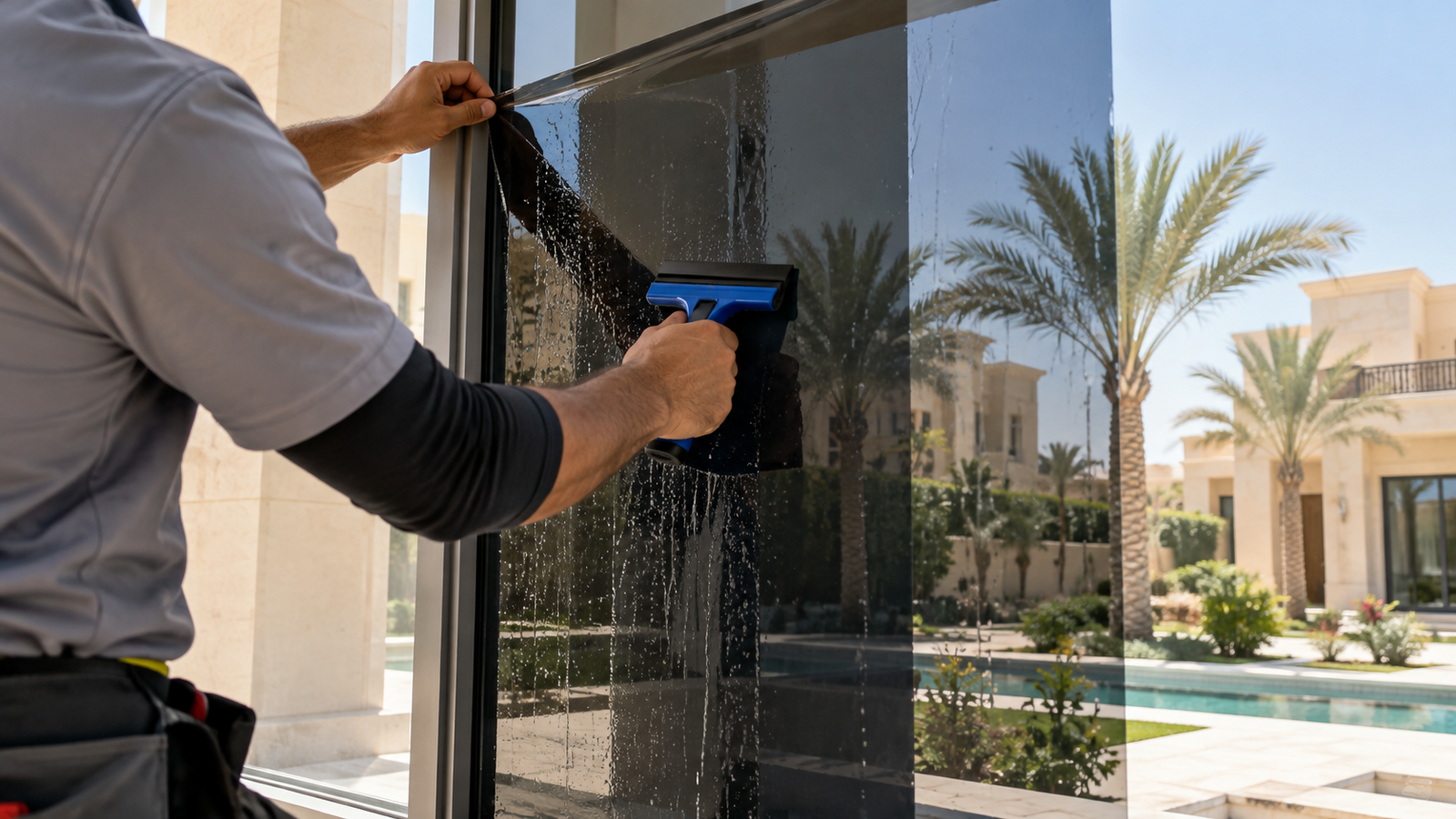

If the sun streams through the windows and makes some rooms in the villa hot or causes strong glare, it is natural to think about window tinting film.
But does film really reduce heat?
Do all types of tinting give the same result?
And is it better to use traditional tinting film or smart film?
The answer depends on the glass type, the window’s direction, the film type, and the installation method.
In this guide, we explain the most important things you need to know before installing window tinting in your villa.
What Is Window Tinting Film?
Window tinting film is a layer applied to the surface of the glass to control part of the solar radiation, light, and glare, according to the film’s specifications.
Films differ in:
- Tinting degree.
- Light transmission.
- Heat control.
- Privacy.
- Appearance.
- UV protection, depending on the product.
So the phrase “tinting film” alone is not enough to define performance.
Does Tinting Film Really Reduce Heat?
Yes, choosing the right film can help reduce solar heat gain through the glass.
But the amount of improvement differs from one project to another.
For example, a window facing west that receives direct afternoon sun is not the same as a window that is already shaded.
The type of glass itself also affects the result.
So do not rely on a general figure like “reduces heat by X percent” without knowing the product’s specifications and the nature of the glass and location.
What Factors Determine the Film’s Effectiveness?
Window Direction
West-facing windows are usually more exposed to afternoon sun.
Glass Type
Single glass differs from double glazing, and low-emissivity glass differs from traditional types.
Film Type
Every film has different specifications.
Glass Area
The larger the glass area, the greater its effect on the solar load inside the space.
Existing Outdoor Shading
An awning or external louvers can reduce the sun reaching the glass before it reaches the film.
This is an important reason why outdoor shading + film can be more effective in some projects than relying on film alone.
Does Film Block Visibility from Outside?
Not all films block visibility in the same way.
Some types provide a greater privacy effect, while others are nearly transparent.
The privacy effect also depends on the lighting difference between inside and outside the building.
So do not rely on the idea:
“Reflective film = 100% privacy”
Because the result changes with lighting conditions.
What Tinting Percentage Is Suitable?
There is no single percentage that suits every villa.
If the room is already dark, choosing a very dark film can reduce natural light more than desired.
But if the problem is strong glare and direct sun, you may need a higher level of control.
So the choice depends on:
- Window direction.
- The room’s function.
- The desired lighting level.
- Privacy.
- Heat.
What Is the Difference Between Tinting Film and Smart Film?
Traditional tinting film has a relatively fixed visual level after installation.
Smart film, on the other hand, includes technologies that allow the glass state to be changed electronically, depending on the system used.
In other words:
Traditional film: a fixed solution.
Smart film: a controllable solution.
But smart film is usually more complex in terms of technology and cost, so it is not necessary for every window.
When Should I Choose Traditional Film?
If your main goal is:
- Reducing glare.
- Reducing part of solar heat gain.
- Improving privacy, depending on the film type.
- Adding a protective layer, depending on the product.
Then traditional film can be a practical option.
When Should I Consider Smart Film?
If the project relies more heavily on:
- Smart Home.
- Privacy control.
- Advanced glass solutions.
- Meeting rooms.
- Modern offices.
- Facades that need variable control.
Then smart film can be worth studying.
Is Film Enough on Its Own?
Not always.
If you have a large west-facing facade, film can help, but outdoor shading may be more important in reducing solar radiation reaching the glass in the first place.
That is why in some projects the best solution is:
An awning or external louvers + glass film
Instead of relying on film alone.
If you are looking for outdoor shading solutions, you can explore adjustable aluminum awnings.
Does Film Affect Natural Lighting?
Yes, according to the degree of light transmission.
The darker the film, the more incoming light can decrease.
But some films are designed to control heat and glare while preserving a good level of natural light.
So do not choose film by color alone.
Is Film Suitable for All Glass Types?
Not necessarily.
Some film types need their compatibility with the glass type assessed, especially because of potential differences in heat absorption and thermal expansion.
So it is best to determine:
- The glass type.
- Its thickness.
- Whether it is single or double.
- Whether it has an existing coating.
- Whether the film is compatible with the glass.
Before installation.
How Long Does Tinting Film Last?
Lifespan varies with film quality, the manufacturer, sun exposure, installation method, and maintenance.
So do not rely on one figure for all products.
Ask about the warranty and expected lifespan according to the specifications of the product itself.
Common Mistakes in Installing Window Films
Choosing the Cheapest Film
Not all films are equal.
Choosing Tinting by Color
Appearance is not enough to assess thermal performance.
Ignoring the Glass Type
It can affect the film choice.
Installation Without Proper Surface Preparation
Glass cleanliness and installation method affect the final result.
Expecting the Film to Eliminate Heat Completely
Film reduces some effects of the sun, but it does not turn the window into a complete thermal insulator.
Does Film Save on the Air Conditioning Bill?
It can help reduce the solar load and therefore may contribute to reducing cooling demand, but the amount of saving varies by building.
It is affected by:
- Glass area.
- Facade directions.
- Insulation.
- AC efficiency.
- Temperature.
- User behavior.
- Film type.
So any promise of a fixed savings percentage without an actual study of the building needs caution.
How Do You Choose the Right Film for the Villa?
Define the purpose first:
Heat?
Focus on thermal performance.
Glare?
Focus on light control.
Privacy?
Choose the type suited to that goal.
Appearance?
Choose the color and finish after confirming performance.
A smart solution?
Study smart film.
Conclusion
Window tinting film can be a practical solution for villas suffering from sun and glare, but the result depends heavily on choosing the right film and installing it correctly.
And do not assume all films are alike.
Before installation, know:
- Window direction.
- Glass type.
- The required tinting level.
- Light transmission.
- The film’s main purpose.
- The warranty.
- The film’s compatibility with the glass.
And if the facade is strongly exposed to the sun, do not rule out outdoor shading solutions.
Frequently Asked Questions
Does tinting film reduce heat?
Yes, it can reduce part of solar heat gain, depending on the film’s specifications, the glass, and site conditions.
Does it block visibility from outside?
It depends on the film type and the lighting inside and outside the building.
Does it affect natural lighting?
Yes, according to the film’s degree of light transmission.
Is smart film better?
Not necessarily. Smart film suits cases that need variable control, while traditional film can be more sensible for simpler uses.
Do I need an awning with the film?
For some facades, combining outdoor shading with film can give a better result than relying on film alone.
Need to Choose the Right Film for Your Villa’s Glass?
If you are hesitating between tinting film types or do not know what suits your facade, it is best to assess the glass type and window directions before choosing a product.
Explore shading solutions from STeam to learn about the options suitable for your project.